I want to recommend this article, linked through Arts & Letters Daily. It's about Shakespeare's universality and the reception of his plays in other cultures (German, Czech, Japanese). It's really interesting and makes me want to pick up my Riverside.
Speaking of Shakespeare, it's funny how often his name comes up in my Greek Tragedy seminar.
Friday, March 02, 2007


Friday, January 12, 2007
Dante's new nose

Can you picture Dante, or his famous profile? His iconography is pretty static, yet now new research has concluded that his famous straight aquiline nose was more "pudgy" and "crooked!" Check out the article here. If anyone finds a visual recreation of the "new nose" let me know!
Wednesday, August 09, 2006
new Archimedes
I admit, my first exposure to Archimedes was through Merlin's pet owl in The Sword in the Stone, but it's the classicist in me that finds a discovery of some previously unknown texts of his so exciting. The story is here, and includes some cool pictures.
Sunday, April 09, 2006
A book to make your skin crawl...
I found on the Drudge Report today a link entitled, "Ancient Book May Be Covered in Human Skin..." This piqued my interested, because "books" in the ancient Mediterranean were originally made with papyrus (into rolls) and then also with wood and wax (as notebooks, as the work could be "erased"). Then came the transition from roll to codex, when paper was made from worked vellum (calfskin, kidskin, or lambskin). By the Middle Ages, the vellum codex was the way to go-- the baby farm animal skin made a smooth and durable writing surface.
But human skin? I had never heard of such a thing in the ancient world! Here is the link to the article. You'll notice that the "ancient" book is only 300 years old! The OED gives the first definition of ancient as "old," so technically, 300 years ago could be considered "ancient." I'm fine with that, but I'm much more comfortable with the second definition: "2. esp. Which existed in, or belonged to, times long past, or early in the world's history; old." I like that "especially."
And the third is the best: "3. a. Specifically applied to the period of history before the fall of the Western Roman Empire. In this sense contrasted with modern, and medieaval. b. Concerning or relating to ancient times."
By the way, the Yorkshire Police article is appropriately more subdued about the "human skin" aspect of the book. And here are some pictures.
But human skin? I had never heard of such a thing in the ancient world! Here is the link to the article. You'll notice that the "ancient" book is only 300 years old! The OED gives the first definition of ancient as "old," so technically, 300 years ago could be considered "ancient." I'm fine with that, but I'm much more comfortable with the second definition: "2. esp. Which existed in, or belonged to, times long past, or early in the world's history; old." I like that "especially."
And the third is the best: "3. a. Specifically applied to the period of history before the fall of the Western Roman Empire. In this sense contrasted with modern, and medieaval. b. Concerning or relating to ancient times."
By the way, the Yorkshire Police article is appropriately more subdued about the "human skin" aspect of the book. And here are some pictures.
Monday, March 27, 2006
Potato Chip Mystery
Today at lunch I was enjoying "Herr's Kettle Cooked Potato Chips, Mesquite BBQ flavored." While I ate, I read the ingredients, as I am wont to do. Here they are:
"choice potatoes cooked in vegetable oil (contains one or more of the following: corn, cottonseed, soybean), sugar, dextrose, malted barley flour, torula yeast, salt, tomato, paprika, onion, monosodium glutamate, garlic, citric acid, spice, mesquite smoke, extractives of paprika, grill flavor (partially hydrogenated cottonseed and soybean oil), less than 22 PPM sulfiting agents and not more than 2% silicon dioxide added (as anticaking agent)."
Did you catch it?
"choice potatoes cooked in vegetable oil (contains one or more of the following: corn, cottonseed, soybean), sugar, dextrose, malted barley flour, torula yeast, salt, tomato, paprika, onion, monosodium glutamate, garlic, citric acid, spice, mesquite smoke, extractives of paprika, grill flavor (partially hydrogenated cottonseed and soybean oil), less than 22 PPM sulfiting agents and not more than 2% silicon dioxide added (as anticaking agent)."
What is this "spice," that it should be labeled separately from salt, paprika, etc., but not defined? Mysterious. Similar to the "natural flavor" phenomenon, where products list both "natural and artificial flavors" as well as other specific ingredients. Why are some shrouded in secrecy, hiding behind these generic names?
I was also curious about "torula yeast." According to Park Tonks Ltd., based in the UK, "Torula Yeast is an inactive yeast, grown as a natural culture and then pasteurised and spray-dried. Torula Yeast is a fine, light grey-brown powder with a slightly yeasty odour and gentle meaty taste. This product is vegan, GMO free, Halal and Kosher certified." And my favorite, "Due to the product's high nutritional value, Torula Yeast is an ideal inclusion into pet foods to improve flavour and palatability."
I also found a definition from Spicy Globe Enterprises, based in Canada, "The Candida Yeast, also known as Torula Yeast, is cultivated in a pure culture containing the sugars and minerals derived from wood. After the fermentation is terminated, the yeasts are separated from the substrates, subsequently are washed carefully to eliminate any residues. Then, the yeast is thermolyzed, pasteurized and pulverized. The yeast cells burst during the thermolysis process and become inactive. They lose their capacity of fermentation but are considered a highly digestible and nutritious food."
Yum yum!
Oh, and I love the word "anticaking," which, incidentally, is not found in the OED.
My friend was enjoying the unflavored variety of Herr's Kettle Cooked Potato Chips. The ingredients:
"choice potatoes cooked in vegetable oil (contains one or more of the following: corn, cottonseed, soybean) and salt. no preservatives added."
He didn't know what he was missing.
"choice potatoes cooked in vegetable oil (contains one or more of the following: corn, cottonseed, soybean), sugar, dextrose, malted barley flour, torula yeast, salt, tomato, paprika, onion, monosodium glutamate, garlic, citric acid, spice, mesquite smoke, extractives of paprika, grill flavor (partially hydrogenated cottonseed and soybean oil), less than 22 PPM sulfiting agents and not more than 2% silicon dioxide added (as anticaking agent)."
Did you catch it?
"choice potatoes cooked in vegetable oil (contains one or more of the following: corn, cottonseed, soybean), sugar, dextrose, malted barley flour, torula yeast, salt, tomato, paprika, onion, monosodium glutamate, garlic, citric acid, spice, mesquite smoke, extractives of paprika, grill flavor (partially hydrogenated cottonseed and soybean oil), less than 22 PPM sulfiting agents and not more than 2% silicon dioxide added (as anticaking agent)."
What is this "spice," that it should be labeled separately from salt, paprika, etc., but not defined? Mysterious. Similar to the "natural flavor" phenomenon, where products list both "natural and artificial flavors" as well as other specific ingredients. Why are some shrouded in secrecy, hiding behind these generic names?
I was also curious about "torula yeast." According to Park Tonks Ltd., based in the UK, "Torula Yeast is an inactive yeast, grown as a natural culture and then pasteurised and spray-dried. Torula Yeast is a fine, light grey-brown powder with a slightly yeasty odour and gentle meaty taste. This product is vegan, GMO free, Halal and Kosher certified." And my favorite, "Due to the product's high nutritional value, Torula Yeast is an ideal inclusion into pet foods to improve flavour and palatability."
I also found a definition from Spicy Globe Enterprises, based in Canada, "The Candida Yeast, also known as Torula Yeast, is cultivated in a pure culture containing the sugars and minerals derived from wood. After the fermentation is terminated, the yeasts are separated from the substrates, subsequently are washed carefully to eliminate any residues. Then, the yeast is thermolyzed, pasteurized and pulverized. The yeast cells burst during the thermolysis process and become inactive. They lose their capacity of fermentation but are considered a highly digestible and nutritious food."
Yum yum!
Oh, and I love the word "anticaking," which, incidentally, is not found in the OED.
My friend was enjoying the unflavored variety of Herr's Kettle Cooked Potato Chips. The ingredients:
"choice potatoes cooked in vegetable oil (contains one or more of the following: corn, cottonseed, soybean) and salt. no preservatives added."
He didn't know what he was missing.
Tuesday, March 21, 2006
Sub Colosseo

I took this photo in the summer of 2002. It reminds me of the image posted on December 15, 2005 in the post Photo test--Temple, in that the angle and the way the sun hits the building each make the Colosseum look majestic.
Wednesday, March 15, 2006
"Happy" Ides of March
 Alright, so today is the Ides of March, so I thought I'd do a little post in honor of Julius Caesar. Since it is upon Shakespeare that the popular understanding of the term "Ides of March" depends, I thought I'd pull a little quotation from the play to pay homage.
His wife Calpurnia is trying to get Caesar to stay in today, as there have been several prophesies of his death. But our Caesar, who had faced and defeated thousands upon thousands of barbarous Gauls and not quite so many Britons, Republicans, and Africans, was not worried about that togate band, most of whom he had previously pardoned. Here's what Shakespeare has him say in Julius Caesar, Act II, scene ii:
Servant: They would not have you to stir forth to-day.The part about the beast without a heart is based on an actual quotation reported by Suetonius, Life of Julius Caesar ch. 77.
Plucking the entrails of an offering forth,
They could not find a heart within the beast.
Caesar: The gods do this in shame of cowardice:
Caesar should be a beast without a heart,
If he should stay at home to-day for fear.
No, Caesar shall not: danger knows full well
That Caesar is more dangerous than he:
We are two lions litter'd in one day,
And I the elder and more terrible:
And Caesar shall go forth.
I'd also like to remark also upon the famous last words of Caesar according to Shakespeare. et tu, Brute? "Even you, Brutus?" That's pretty good drama. Even cooler though is the phrase ascribed to him by the ancient, albeit sensationalistic, Suetonius. καὶ σὺ τέκνον; "Even you, child?" "Child" being perhaps particularly appropriate because at one time Brutus might have been engaged to Caesar's beautiful daughter Julia and that Caesar had a long-term affair with Brutus' mother.
P.S. According to Wikipedia, Caesar was the first Roman to have his portrait put on coins while he was still alive. Check out his issues with thumbnails or without.
Sunday, March 12, 2006
Housmania
I was first introduced to A.E. Housman (1859-1936) by my professor of 17th c. poetry back in undergrad. He saw that I was always picking up on and excited about classical references in our Marvell, Donne, et al., so he told me to check out A.E. Housman's To An Athlete Dying Young, which echoes Pindaric odes. When I came to graduate school, I learned that Housman was a classicist as well as poet-- in fact, the best of his generation, particularly known as a textual critic. So today I thought I'd post that poem, which is good even without Pindar in your pocket.
The time you won your town the race
We chaired you through the market-place;
Man and boy stood cheering by,
And home we brought you shoulder-high.
To-day, the road all runners come,
Shoulder-high we bring you home,
And set you at your threshold down,
Townsman of a stiller town.
Smart lad, to slip betimes away
From fields where glory does not stay
And early though the laurel grows
It withers quicker than the rose.
Eyes the shady night has shut
Cannot see the record cut,
And silence sounds no worse than cheers
After earth has stopped the ears;
Now you will not swell the rout
Of lads that wore their honours out,
Runners whom renown outran
And the name died before the man.
So set, before its echoes fade,
The fleet foot on the sill of shade,
And hold to the low lintel up
The still-defended challenge-cup.
And round that early-laurelled head
Will flock to gaze the strengthless dead,
And find unwithered on its curls
The garland briefer than a girl's.
The time you won your town the race
We chaired you through the market-place;
Man and boy stood cheering by,
And home we brought you shoulder-high.
To-day, the road all runners come,
Shoulder-high we bring you home,
And set you at your threshold down,
Townsman of a stiller town.
Smart lad, to slip betimes away
From fields where glory does not stay
And early though the laurel grows
It withers quicker than the rose.
Eyes the shady night has shut
Cannot see the record cut,
And silence sounds no worse than cheers
After earth has stopped the ears;
Now you will not swell the rout
Of lads that wore their honours out,
Runners whom renown outran
And the name died before the man.
So set, before its echoes fade,
The fleet foot on the sill of shade,
And hold to the low lintel up
The still-defended challenge-cup.
And round that early-laurelled head
Will flock to gaze the strengthless dead,
And find unwithered on its curls
The garland briefer than a girl's.
Wednesday, February 01, 2006
return to the rostra
I know, I know, it's been a while. New semester.
Last night President Bush gave his State of the Union address (by the way, isn't it funny that the corresponding governor's speeches are called 'State of the State' addresses?), and both the NBC commentators and President Bush himself called the platform from which he spoke a "rostrum." The fellow classicists in the room and I were puzzled, because in Latin, a rostrum is a beak of a ship. The speaking platform in the Forum from which greats like Cicero and Ceasar spoke was the rostra, the plural of rostrum, because it was adorned with ship's beaks to commemorate naval victories. So, dutifully, I looked the word up in the OED to see what the current English usage was. The first entry describes the Roman rostra as an English word, and then goes on to say, "The singular form, though strictly incorrect, is the one commonly employed in this sense (i.e., the sense of a speaking platform)." So I guess it's okay to say "rostrum" when describing a place for public speaking, since it's in the OED and all, but it sure sounds weird when you know it means a ship's beak. This meaning does still exist in English, as well, and is found in the lower recesses of the entry on rostrum in the OED, so it's not just that Latinists are remembering something wholly lost in English.
Last night President Bush gave his State of the Union address (by the way, isn't it funny that the corresponding governor's speeches are called 'State of the State' addresses?), and both the NBC commentators and President Bush himself called the platform from which he spoke a "rostrum." The fellow classicists in the room and I were puzzled, because in Latin, a rostrum is a beak of a ship. The speaking platform in the Forum from which greats like Cicero and Ceasar spoke was the rostra, the plural of rostrum, because it was adorned with ship's beaks to commemorate naval victories. So, dutifully, I looked the word up in the OED to see what the current English usage was. The first entry describes the Roman rostra as an English word, and then goes on to say, "The singular form, though strictly incorrect, is the one commonly employed in this sense (i.e., the sense of a speaking platform)." So I guess it's okay to say "rostrum" when describing a place for public speaking, since it's in the OED and all, but it sure sounds weird when you know it means a ship's beak. This meaning does still exist in English, as well, and is found in the lower recesses of the entry on rostrum in the OED, so it's not just that Latinists are remembering something wholly lost in English.
Tuesday, December 27, 2005
et in Arcadia ego
This evening I decided to start going through my books here at home to catalogue on LibraryThing, and I came across quite a few fun things on my shelves I had forgotten about. One of these was Arcadia by Tom Stoppard. I saw it performed several years ago and liked it, so I bought it. Well, upon finding it, I read the brief play tonight, and thoroughly enjoyed it. I remember that when I first saw the play that there were several references, literary, Latin, and the like, that I picked up on but didn't understand-- it was pleasant this time around, years later, to get some of these witticisms.
One theme of the play I can particularly appreciate as I toil in the academic world is the picture of the scholars who pick through the historical record-- notes in books, pictures, scraps, etc.-- to try to piece together scenes from the past. That they get it so wrong because they find only what they're looking for is practically a universal truth.
The way Stoppard alternates (and doesn't) between past and present is quite astonishing, as well. The fact that I enjoyed it again and yet still didn't get the full mathematical/philosophical complexities means I'll just have to pick it up again in a few years.
One theme of the play I can particularly appreciate as I toil in the academic world is the picture of the scholars who pick through the historical record-- notes in books, pictures, scraps, etc.-- to try to piece together scenes from the past. That they get it so wrong because they find only what they're looking for is practically a universal truth.
The way Stoppard alternates (and doesn't) between past and present is quite astonishing, as well. The fact that I enjoyed it again and yet still didn't get the full mathematical/philosophical complexities means I'll just have to pick it up again in a few years.
Monday, December 26, 2005
Dante Comic
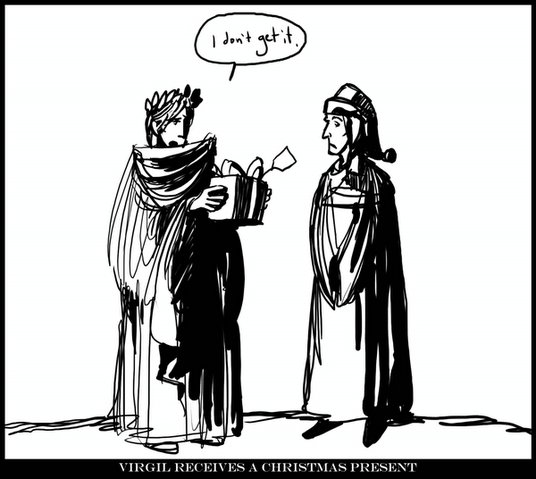 Okay, here's a post appropriate for the holidays-- a Dante comic. It's just dorky enough for my taste. I found it by following a search link (searching blogs for "dante") that led someone to my blog-- the search also listed this post. Many thanks to rubinesque, from whom I snatched this photo-- I only reproduce it (and not only link to it) because I didn't think everyone would follow the link, and they'd miss out on the image. I love that it follows the traditional iconography for Dante and Vergil, too.
Monday, December 19, 2005
'Losers' win...at love!
Who knew my mother could give me such a hot tip? She just informed me that 'Biggest Loser' Matt and runner-up Suzy are now dating. The Biggest Loser was one of the few shows I watched this fall, primarily because of its timeslot before House, the best drama on tv. I guess I should have guessed when Matt let Suzy give him a dramatic haircut towards the end of the season-- only a few episodes before the gang had gone for makeovers at a fancy salon and he'd refused a major cut. Well, best of luck to them both.
Thursday, December 15, 2005
Photo test-- Temple
 So here I am trying out Picasa's blogging feature. This is a photo I took when in Rome in the summer of 2002. It's the temple to the Divine Faustina and Antoninus Pius. Here's a link to an image of the front. I always liked the dramatic look of this shot, it seemed majestic to me.
Tuesday, December 13, 2005
the complexity of Dante's "Vergil"
Here's another quotation that won't make it into the paper, but I wanted to share:
“But Dante’s Vergil, particularly in the Inferno, is far more than a prophetic author and exemplary guide. He is also a tragic figure whose intellectual, emotional and psychological complexity accounts for much of the dramatic energy in Dante’s poem. After all, most of the action of the journey through Hell involves Vergil in some way, usually through his relationship to the pilgrim, himself a creation of the poet. Although Vergil appears most often as a wise guide and a source of knowledge for the pilgrim, there are crucial moments when Dante the poet seems to undermine Vergil’s authority and credibility in order to enrich the aesthetic and moral structure of his poetic universe.”
Guy P. Raffa, “Dante’s Beloved Yet Damned Virgil” in Dante Aligheri, Inferno: The Indiana Critical Edition. ed. and trans., Mark Musa. (Indianapolis , Ind.
“But Dante’s Vergil, particularly in the Inferno, is far more than a prophetic author and exemplary guide. He is also a tragic figure whose intellectual, emotional and psychological complexity accounts for much of the dramatic energy in Dante’s poem. After all, most of the action of the journey through Hell involves Vergil in some way, usually through his relationship to the pilgrim, himself a creation of the poet. Although Vergil appears most often as a wise guide and a source of knowledge for the pilgrim, there are crucial moments when Dante the poet seems to undermine Vergil’s authority and credibility in order to enrich the aesthetic and moral structure of his poetic universe.”
Guy P. Raffa, “Dante’s Beloved Yet Damned Virgil” in Dante Aligheri, Inferno: The Indiana Critical Edition. ed. and trans., Mark Musa. (
Monday, December 12, 2005
Dante, "thinker and poet"
As I work on my Dante & Vergil paper for my Reception course, I find I won't be able to work in this great quotation, so I'm going to share it here. Domenico Comparetti (VMA pg. 199) presents Dante as a poet of the Middle Ages, yet distinguishes what sets him apart from his contemporaries:
"[Dante] has a high opinion of the human intellect, and though he considers its powers as limited, yet he feels a great respect for those of its representatives who were independent of and anterior to the mission of Christ; hence he is not merely acquainted with the ancients through the medium of the schools of grammar, nor does he confine his study of them to what is barely necessary, but he devotes himself directly to them, not as a grammarian or a philologist, still less as a humanist, but as a thinker and a poet."
"[Dante] has a high opinion of the human intellect, and though he considers its powers as limited, yet he feels a great respect for those of its representatives who were independent of and anterior to the mission of Christ; hence he is not merely acquainted with the ancients through the medium of the schools of grammar, nor does he confine his study of them to what is barely necessary, but he devotes himself directly to them, not as a grammarian or a philologist, still less as a humanist, but as a thinker and a poet."
Saturday, December 10, 2005
fun with Greek
My 'baby Greek' textbook, From Alpha to Omega, began every chapter with a fun little phrase in Ancient Greek. These are two I liked:
This one is from Lession 18 (pg. 109)
"νίψον ἀνόμημα μὴ μόναν ὄψιν
(Wash off your sin, not only your face)
--palindrome on a font in the cathedral of the Hagia Sophia, Istanbul"
Palindrome is a Greek word, too-- πάλιν is an adverb meaning "back, again, once more" and δραμεῖν (aor. of τρέχειν) is the verb "to run" so a παλίνδρομος is a "running back again" (Liddell & Scott).
This one is from Lesson 49 (pg. 347)
"τὰ δ' ἄλλα σιγῶ· βοῦς ἐπὶ γλώσσῃ μέγας / βέβηκε
(about the rest, I'm silent-- a great ox has stepped on my tongue)
--the palace guard is afraid to say more in Aeschylus' Agamemnon 36-37"
Apparently Aeschylus is known for his wacky images like this. Sure wish I had the time/opportunity to read the great tragedians in the original-- οἴμοι (that was my favorite word in Greek as an undergrad. It means "woe to me!" or "alas!" and is primarily found in Tragedy).
This one is from Lession 18 (pg. 109)
"νίψον ἀνόμημα μὴ μόναν ὄψιν
(Wash off your sin, not only your face)
--palindrome on a font in the cathedral of the Hagia Sophia, Istanbul"
Palindrome is a Greek word, too-- πάλιν is an adverb meaning "back, again, once more" and δραμεῖν (aor. of τρέχειν) is the verb "to run" so a παλίνδρομος is a "running back again" (Liddell & Scott).
This one is from Lesson 49 (pg. 347)
"τὰ δ' ἄλλα σιγῶ· βοῦς ἐπὶ γλώσσῃ μέγας / βέβηκε
(about the rest, I'm silent-- a great ox has stepped on my tongue)
--the palace guard is afraid to say more in Aeschylus' Agamemnon 36-37"
Apparently Aeschylus is known for his wacky images like this. Sure wish I had the time/opportunity to read the great tragedians in the original-- οἴμοι (that was my favorite word in Greek as an undergrad. It means "woe to me!" or "alas!" and is primarily found in Tragedy).
Friday, December 02, 2005
Hamlet in German
At a book sale several weeks ago, Dennis picked up for me Werke in zwei Bänden-- The complete works of Shakespeare in German! I love to flip to passages I am familiar with in the English, and compare them to the German-- it's much easier to read the German than you'd imagine-- especially because Shakespeare's English was even closer to German than ours is today. I've reproduced here both the English and German of one of my favorite passages of Shakespeare, from Hamlet II.ii, in which Rosencrantz and Guildenstern are trying to figure out what's up with the "mad" prince, but Hamlet realizes they've been sent for by the king for this very task. Here is his response to them:
Text from the recent Cambridge edition of Shakespeare's Hamlet, ed. Philip Edwards (Cambridge: 2003). II.ii.280-291:
...I have of late, but wherefore I know not, lost all my mirth, forgone all custom of exercises; and indeed it goes so heavily with my disposition that this goodly frame, the earth, seems to me a sterile promontory; this most excellent canopy the air, look you, this brave o'erhanging firmament, this majestical roof fretted with golden fire,-- why, it appeareth no other thing to me but a foul and pestilent congregation of vapours. What a piece of work is a man! How noble in reason, how infinite in faculties, in form and moving how express and admirable, in action how like an angel, in apprehension how like a god! The beauty of the world, the paragon of animals-- and yet to me, what is this quintessence of dust? Man delights not me..."
And in German (note: for each "eszet" in the text of the book, I have typed double "s" here, and each umlaut has become the vowel followed by "e"):
Ich habe seit kurzem-- ich weiss nicht, wodurch,-- alle meine Munterkeit eingebuesst, meine gewohnten Uebungen aufgegeben, und es steht in der Tat so uebel um meine Gemuetslage, dass die Erde, dieser treffliche Bau, mir nur ein kahles Vorgebirge scheint, seht irh, dieser herrliche Baldachin, die Luft, dies praechtige umwoelbende Firmament, dies majestaetische Dach mit goldnem Feuer ausgelegt: kommt es mir doch nicht anders vor als ein fauler, verpesteter Haufe von Duensten. Welch ein Meisterwerk ist der Mensch! Wie edel durch Vernunft! Wie unbegrenzt an Faehigkeiten! In Gestalt und Bewegung wie ausdrucksvoll und wunderwuerdig! Im Handeln wie aehnlich aenem Engel! Im Begreifen wie aenlich einem Gott! Die Zierde der Welt! Das Vorbild der Lebendigen! Und doch, was ist mir diese Quintessenz von Staube? Ich habe keine lust am Manne...
I especially like the parts: "this majestical roof fretted with golden fire" = "dies majestaetische Dach mit goldnem Feuer ausgelegt" and all of the exclamations at the end starting with: "What a piece of work is a man!" = "Welch ein Meisterwerk ist der Mensch!" and don't forget: "and yet to me, what is this quintessence of dust?" = "Und doch, was ist mir diese Quintessenz von Staube?"
If there are any requests of favorite parts in Shakespeare that you'd be curious to see in German, let me know. I think it's a fun distraction-- and probably helps with my German!
Text from the recent Cambridge edition of Shakespeare's Hamlet, ed. Philip Edwards (Cambridge: 2003). II.ii.280-291:
...I have of late, but wherefore I know not, lost all my mirth, forgone all custom of exercises; and indeed it goes so heavily with my disposition that this goodly frame, the earth, seems to me a sterile promontory; this most excellent canopy the air, look you, this brave o'erhanging firmament, this majestical roof fretted with golden fire,-- why, it appeareth no other thing to me but a foul and pestilent congregation of vapours. What a piece of work is a man! How noble in reason, how infinite in faculties, in form and moving how express and admirable, in action how like an angel, in apprehension how like a god! The beauty of the world, the paragon of animals-- and yet to me, what is this quintessence of dust? Man delights not me..."
And in German (note: for each "eszet" in the text of the book, I have typed double "s" here, and each umlaut has become the vowel followed by "e"):
Ich habe seit kurzem-- ich weiss nicht, wodurch,-- alle meine Munterkeit eingebuesst, meine gewohnten Uebungen aufgegeben, und es steht in der Tat so uebel um meine Gemuetslage, dass die Erde, dieser treffliche Bau, mir nur ein kahles Vorgebirge scheint, seht irh, dieser herrliche Baldachin, die Luft, dies praechtige umwoelbende Firmament, dies majestaetische Dach mit goldnem Feuer ausgelegt: kommt es mir doch nicht anders vor als ein fauler, verpesteter Haufe von Duensten. Welch ein Meisterwerk ist der Mensch! Wie edel durch Vernunft! Wie unbegrenzt an Faehigkeiten! In Gestalt und Bewegung wie ausdrucksvoll und wunderwuerdig! Im Handeln wie aehnlich aenem Engel! Im Begreifen wie aenlich einem Gott! Die Zierde der Welt! Das Vorbild der Lebendigen! Und doch, was ist mir diese Quintessenz von Staube? Ich habe keine lust am Manne...
I especially like the parts: "this majestical roof fretted with golden fire" = "dies majestaetische Dach mit goldnem Feuer ausgelegt" and all of the exclamations at the end starting with: "What a piece of work is a man!" = "Welch ein Meisterwerk ist der Mensch!" and don't forget: "and yet to me, what is this quintessence of dust?" = "Und doch, was ist mir diese Quintessenz von Staube?"
If there are any requests of favorite parts in Shakespeare that you'd be curious to see in German, let me know. I think it's a fun distraction-- and probably helps with my German!
Monday, November 28, 2005
Dante's house
Some friends of mine in Italy had the pleasure of visiting "Dante's house" in Florence recently. Besides being very jealous, I am excited about the cool pictures. Here is the link. Thanks Hutchinsons! Check out how Eric manages to use the words "Inferno" and "haunts" in the same sentence.
Sunday, November 27, 2005
Fitzgerald's "Aeneid" Postscript
The Postscript to Fitzgerald's translation of Vergil's Aeneid is good. In sections v and vi he puts the war scenes in the context of the Vergil's times, the social war and Civil wars. As I read these last six books (the "neglected" books) in my Aeneid seminar, I keep recalling the end of section vi (pg. 414):
I first read through all twelve books of The Aeneid in my Oxford Classical Text in the spring, summer, and early fall of 1945, the closing months of the Second Great War, when I was stationed on an island in the western Pacific. Living and working in commodious Quonset huts on neat coral driveways amid palms regularly treated by DDT sprayed from a slow biplane, staff oficers had little to suffer but boredom off duty, and Virgil remedied that for me. Our navy's Actium had been fought long before at Midway. But the last island fighting continued, first at Iwo, then on Okinawa, where kamikaze season got into full swing. There we were on our island in our fresh khakis, laundered and pressed, the little bars gleaming on our collars and caps, saluting the old admiral with his snowy Roman head and the urbane operations officer who held in his crystal mind the location, course, destination, and speed of every least landing craft over thousands of miles. The scene could not have been more imperial or more civilized. APO mail from the States came fast. We played tennis, skipped rope, and worked out on the heavy bag. At night at my neat desk in the B.O.Q. I read Virgil by the light of a good lamp. I heard young submarine skippers, the finest Annapolis products, give their lighthearted accounts of shelling poor junks to smithereens in the China Sea. Meanwhile, offshore of the big Japanese island to the north, picket ships where having their prows or upperworks and the men who manned them smashed into flaming junk by Japanese fighters aflame; ashore, men with flamethrowers were doing what I had heard a briefing officer in Sanf Fransisco, with an insane giggle, refer to as "popping Japs;" and a good many young and brave of both sides were tasting the agony and abomination that the whole show came down to, in fact existed for. The next landings would be on Honshu, and I would be there. More than literary interest, I think, kept me reading Virgil's description of desperate battle, funeral pyres, failed hopes of truce or peace.Some of my friends and I in the seminar keep discussing the emphasis on the first six books of the Aeneid by most modern readers. Vergil, however, calls his second "Iliadic" half his maius opus, or "greater task," in line 44 of Book 7. It has been somewhat of a discovery process for me to read these books now, though I'd read the poem in translation before. Now that I'm really examining Vergil's work, the war scenes seem to me some of his most powerful poetry.
More than literary interest surely moved the first Roman readers of these books of The Aeneid, for war, the Roman specialty, had within their memories gone fratricidal and got out of hand. If Virgil intended, as he almost certainly did, an analogy between the task of Aeneas and that of Augustus, the hardest and hugest part for both was waging war to end war, to work out settlements so magnanimous as to challenge no more strife but to promote concordia and the arts of peace.
Thursday, November 24, 2005
Alberti to Brunelleschi about the Duomo
A draft of this post has been sitting for a while, but I find myself with some free time this Thanksgiving holiday.
For my class on Reception (of the classical world) a couple of weeks ago, I was assigned to read a letter from Alberti to Brunelleschi. For those interested, here's a site with some pictures of Alberti's architectural designs, and here's one for Brunelleschi. Each quote Vasari's Lives of the Artists, which we've also been reading from for Reception, so much so that I've become interested enough to want to own it-- if only I could find a bilingual edition!
As I mentioned in a previous post (Sono italiana in spirito!*), I've become really excited about Italian. As such, I was very pleased that my professor provided both English and Italian versions of the letter. Here's an excerpt, in which Alberti is marvelling about Brunelleschi's architectural accomplishment, the Duomo (i.e. Santa Maria del Fiore) of Florence (from On Painting and On Sculpture, ed. and trans. by Cecil Grayson, Phaidon, 1972):
For my class on Reception (of the classical world) a couple of weeks ago, I was assigned to read a letter from Alberti to Brunelleschi. For those interested, here's a site with some pictures of Alberti's architectural designs, and here's one for Brunelleschi. Each quote Vasari's Lives of the Artists, which we've also been reading from for Reception, so much so that I've become interested enough to want to own it-- if only I could find a bilingual edition!
As I mentioned in a previous post (Sono italiana in spirito!*), I've become really excited about Italian. As such, I was very pleased that my professor provided both English and Italian versions of the letter. Here's an excerpt, in which Alberti is marvelling about Brunelleschi's architectural accomplishment, the Duomo (i.e. Santa Maria del Fiore) of Florence (from On Painting and On Sculpture, ed. and trans. by Cecil Grayson, Phaidon, 1972):
What man, however hard of heart or jealous, would not praise Filippo the architect when he sees here such an enormous construction towering above the skies, vast enough to cover the entire Tuscan population with its shadow, and done without the aid of beams or elaborate wooden supports? Surely a feat of engineering, if I am not mistaken, that people did not believe possible these days and was probably equally unknown and unimaginable among the ancients.
Chi mai sì duro o sì invido non lodasse Pippo architetto vedendo qui struttura sì grande, erta sopra e' cieli, ampla da coprire con sua ombra tutti e' popoli toscani, fatta sanza alcuno aiuto di travamenti o di copia di legname, quale artificio certo, se io ben iudico, come a questi tempi era incredibile potersi, così forse appresso gli antichi fu non saputo né conosciuto?I chose this quotation because the Duomo is my favorite building--it really is awesome (in the original sense of the word), which is what Alberti is trying to convey here. Oh, and notice that Alberti calls his friend by the familiar "Pippo" in the Italian, but that's not reflected in the translation.
Subscribe to:
Posts (Atom)

