Dodds, E.R. "On Misunderstanding the Oedipus Rex." Greece & Rome, 2nd Ser., Vol. 13, No. 1. (Apr., 1966): 37-49.
Tuesday, October 30, 2007
Recommended article-- Greek Tragedy
Reading up for my recent post about the archaic notion of justice, I was reminded of an excellent article also by E.R. Dodds, called "On Misunderstanding the Oedipus Rex." A professor gave it to me when I read the play with him several years ago, and upon reading it again today I was reminded what a valuable part of the Sophoclean bibliography it is. It is brief, only thirteen pages, but points to the major ways the play was misread (by his students) when the article was written in 1966. The article remains a valuable insight into the character of Oedipus, the author Sophocles, and the play itself. I recommend it to all readers of the play as an accessible introduction to thinking about "justice" in the play.


recent takes on Dante
I just want to link this post about the "interpretations" Dante has been getting recently in Italy-- where's this stuff in the states? Granted, people here do this kind of stuff for Shakespeare.
Homer's gods and justice
The opening lines of this post are enough to pique the interest of any Iliad-lover. One of the most interesting things about reading the Iliad is trying to understand the conception of the gods and fate put forth. There are reams of books and articles on the subject. One of the best and most accessible is E.R. Dodds' The Greeks and the Irrational, which my Greek teacher gave us the first few chapters of to introduce us to the issue of the brutal gods in the epic. Here is a passage from page 29 of the UC Press 2004 edition:
"In Iliad 24 Achilles, moved at last by the spectacle of his broken enemy Priam, pronounces the tragic moral of the whole poem: 'For so the gods have spun the thread for pitiful humanity, that the life of man should be sorrow, while themselves are exempt from care.' And he goes on to the famous image of the two jars from which Zeus draws forth his good and evil gifts. To some men he gives a mixed assortment, to others, unmixed evil, so that they wander tormented over the face of the earth 'unregarded by gods or men.' As for the unmixed good, that, we are to assume, is a portion reserved for the gods. The gods have nothing to do with justice: else the moral would be false. For in the Iliad heroism does not bring happiness; its sole, and sufficient, reward is fame. Yet for all that, Homer's princes bestride their world boldly; they fear the gods only as they fear their human overlords, nor are they oppressed by the future even when, like Achilles, they know that it holds an approaching doom."
Wednesday, August 08, 2007
the new big "fluffy" planet
Scientists have discovered a new planet! This short article discusses the find. I'm disappointed in the name, TrES-4. Since it is bigger than Jupiter, shouldn't it be called Kronos or something? Oh but the Star Trek writers already used that name for the Klingon homeworld (pronounced Kronos, spelled Q'onoS). The Klingons wouldn't be pleased with scientists calling their planet "fluffy" though!
Friday, July 20, 2007
Success! Cypriot coins added to ban
At the end of January, a friend of mine working in Athens emailed me to alert me to a campaign to add Cypriot coins to the agreement with Cyprus that had come up for renewal. The agreement restricts the import into the United States of undocumented archaeological materials from Cyprus, but did not include coins. So I emailed the Cultural Property Advisory Committee in the U.S. Department of State, who solicited comments from interested parties about whether or not to add coins to the agreement. Several archaeological organizations encouraged their members to email the committee, and a number of archaeology professors in my school encouraged students individually.
Because of my interest in coins, I am on the mailing list of at least two coin sellers. They each sent emails to their clients, urging them to email the committee and request that coins be kept off the agreement. They stated that the archaeological organizations were rallying their members (as they were) and that these archaeologists were trying to stop the sale of antiquities (including coins) on a large scale (which they are). They warned their clients that their hobby was at risk.
Well, Dennis just sent me this link to an article stating that coins were included in the agreement, and that the "State Department was barraged by letters from personalities of the archaeological and arts world" and I must admit that I got a little swell of pride-- one of those was mine!
Friday, March 02, 2007
Shakespeare Reception
I want to recommend this article, linked through Arts & Letters Daily. It's about Shakespeare's universality and the reception of his plays in other cultures (German, Czech, Japanese). It's really interesting and makes me want to pick up my Riverside.
Speaking of Shakespeare, it's funny how often his name comes up in my Greek Tragedy seminar.
Speaking of Shakespeare, it's funny how often his name comes up in my Greek Tragedy seminar.
Friday, January 12, 2007
Dante's new nose

Can you picture Dante, or his famous profile? His iconography is pretty static, yet now new research has concluded that his famous straight aquiline nose was more "pudgy" and "crooked!" Check out the article here. If anyone finds a visual recreation of the "new nose" let me know!
Wednesday, August 09, 2006
new Archimedes
I admit, my first exposure to Archimedes was through Merlin's pet owl in The Sword in the Stone, but it's the classicist in me that finds a discovery of some previously unknown texts of his so exciting. The story is here, and includes some cool pictures.
Sunday, April 09, 2006
A book to make your skin crawl...
I found on the Drudge Report today a link entitled, "Ancient Book May Be Covered in Human Skin..." This piqued my interested, because "books" in the ancient Mediterranean were originally made with papyrus (into rolls) and then also with wood and wax (as notebooks, as the work could be "erased"). Then came the transition from roll to codex, when paper was made from worked vellum (calfskin, kidskin, or lambskin). By the Middle Ages, the vellum codex was the way to go-- the baby farm animal skin made a smooth and durable writing surface.
But human skin? I had never heard of such a thing in the ancient world! Here is the link to the article. You'll notice that the "ancient" book is only 300 years old! The OED gives the first definition of ancient as "old," so technically, 300 years ago could be considered "ancient." I'm fine with that, but I'm much more comfortable with the second definition: "2. esp. Which existed in, or belonged to, times long past, or early in the world's history; old." I like that "especially."
And the third is the best: "3. a. Specifically applied to the period of history before the fall of the Western Roman Empire. In this sense contrasted with modern, and medieaval. b. Concerning or relating to ancient times."
By the way, the Yorkshire Police article is appropriately more subdued about the "human skin" aspect of the book. And here are some pictures.
Monday, March 27, 2006
Potato Chip Mystery
Today at lunch I was enjoying "Herr's Kettle Cooked Potato Chips, Mesquite BBQ flavored." While I ate, I read the ingredients, as I am wont to do. Here they are:
"choice potatoes cooked in vegetable oil (contains one or more of the following: corn, cottonseed, soybean), sugar, dextrose, malted barley flour, torula yeast, salt, tomato, paprika, onion, monosodium glutamate, garlic, citric acid, spice, mesquite smoke, extractives of paprika, grill flavor (partially hydrogenated cottonseed and soybean oil), less than 22 PPM sulfiting agents and not more than 2% silicon dioxide added (as anticaking agent)."
Did you catch it?
"choice potatoes cooked in vegetable oil (contains one or more of the following: corn, cottonseed, soybean), sugar, dextrose, malted barley flour, torula yeast, salt, tomato, paprika, onion, monosodium glutamate, garlic, citric acid, spice, mesquite smoke, extractives of paprika, grill flavor (partially hydrogenated cottonseed and soybean oil), less than 22 PPM sulfiting agents and not more than 2% silicon dioxide added (as anticaking agent)."
What is this "spice," that it should be labeled separately from salt, paprika, etc., but not defined? Mysterious. Similar to the "natural flavor" phenomenon, where products list both "natural and artificial flavors" as well as other specific ingredients. Why are some shrouded in secrecy, hiding behind these generic names?
I was also curious about "torula yeast." According to Park Tonks Ltd., based in the UK, "Torula Yeast is an inactive yeast, grown as a natural culture and then pasteurised and spray-dried. Torula Yeast is a fine, light grey-brown powder with a slightly yeasty odour and gentle meaty taste. This product is vegan, GMO free, Halal and Kosher certified." And my favorite, "Due to the product's high nutritional value, Torula Yeast is an ideal inclusion into pet foods to improve flavour and palatability."
I also found a definition from Spicy Globe Enterprises, based in Canada, "The Candida Yeast, also known as Torula Yeast, is cultivated in a pure culture containing the sugars and minerals derived from wood. After the fermentation is terminated, the yeasts are separated from the substrates, subsequently are washed carefully to eliminate any residues. Then, the yeast is thermolyzed, pasteurized and pulverized. The yeast cells burst during the thermolysis process and become inactive. They lose their capacity of fermentation but are considered a highly digestible and nutritious food."
Yum yum!
Oh, and I love the word "anticaking," which, incidentally, is not found in the OED.
My friend was enjoying the unflavored variety of Herr's Kettle Cooked Potato Chips. The ingredients:
"choice potatoes cooked in vegetable oil (contains one or more of the following: corn, cottonseed, soybean) and salt. no preservatives added."
He didn't know what he was missing.
"choice potatoes cooked in vegetable oil (contains one or more of the following: corn, cottonseed, soybean), sugar, dextrose, malted barley flour, torula yeast, salt, tomato, paprika, onion, monosodium glutamate, garlic, citric acid, spice, mesquite smoke, extractives of paprika, grill flavor (partially hydrogenated cottonseed and soybean oil), less than 22 PPM sulfiting agents and not more than 2% silicon dioxide added (as anticaking agent)."
Did you catch it?
"choice potatoes cooked in vegetable oil (contains one or more of the following: corn, cottonseed, soybean), sugar, dextrose, malted barley flour, torula yeast, salt, tomato, paprika, onion, monosodium glutamate, garlic, citric acid, spice, mesquite smoke, extractives of paprika, grill flavor (partially hydrogenated cottonseed and soybean oil), less than 22 PPM sulfiting agents and not more than 2% silicon dioxide added (as anticaking agent)."
What is this "spice," that it should be labeled separately from salt, paprika, etc., but not defined? Mysterious. Similar to the "natural flavor" phenomenon, where products list both "natural and artificial flavors" as well as other specific ingredients. Why are some shrouded in secrecy, hiding behind these generic names?
I was also curious about "torula yeast." According to Park Tonks Ltd., based in the UK, "Torula Yeast is an inactive yeast, grown as a natural culture and then pasteurised and spray-dried. Torula Yeast is a fine, light grey-brown powder with a slightly yeasty odour and gentle meaty taste. This product is vegan, GMO free, Halal and Kosher certified." And my favorite, "Due to the product's high nutritional value, Torula Yeast is an ideal inclusion into pet foods to improve flavour and palatability."
I also found a definition from Spicy Globe Enterprises, based in Canada, "The Candida Yeast, also known as Torula Yeast, is cultivated in a pure culture containing the sugars and minerals derived from wood. After the fermentation is terminated, the yeasts are separated from the substrates, subsequently are washed carefully to eliminate any residues. Then, the yeast is thermolyzed, pasteurized and pulverized. The yeast cells burst during the thermolysis process and become inactive. They lose their capacity of fermentation but are considered a highly digestible and nutritious food."
Yum yum!
Oh, and I love the word "anticaking," which, incidentally, is not found in the OED.
My friend was enjoying the unflavored variety of Herr's Kettle Cooked Potato Chips. The ingredients:
"choice potatoes cooked in vegetable oil (contains one or more of the following: corn, cottonseed, soybean) and salt. no preservatives added."
He didn't know what he was missing.
Tuesday, March 21, 2006
Sub Colosseo

I took this photo in the summer of 2002. It reminds me of the image posted on December 15, 2005 in the post Photo test--Temple, in that the angle and the way the sun hits the building each make the Colosseum look majestic.
Wednesday, March 15, 2006
"Happy" Ides of March
 Alright, so today is the Ides of March, so I thought I'd do a little post in honor of Julius Caesar. Since it is upon Shakespeare that the popular understanding of the term "Ides of March" depends, I thought I'd pull a little quotation from the play to pay homage.
His wife Calpurnia is trying to get Caesar to stay in today, as there have been several prophesies of his death. But our Caesar, who had faced and defeated thousands upon thousands of barbarous Gauls and not quite so many Britons, Republicans, and Africans, was not worried about that togate band, most of whom he had previously pardoned. Here's what Shakespeare has him say in Julius Caesar, Act II, scene ii:
Servant: They would not have you to stir forth to-day.The part about the beast without a heart is based on an actual quotation reported by Suetonius, Life of Julius Caesar ch. 77.
Plucking the entrails of an offering forth,
They could not find a heart within the beast.
Caesar: The gods do this in shame of cowardice:
Caesar should be a beast without a heart,
If he should stay at home to-day for fear.
No, Caesar shall not: danger knows full well
That Caesar is more dangerous than he:
We are two lions litter'd in one day,
And I the elder and more terrible:
And Caesar shall go forth.
I'd also like to remark also upon the famous last words of Caesar according to Shakespeare. et tu, Brute? "Even you, Brutus?" That's pretty good drama. Even cooler though is the phrase ascribed to him by the ancient, albeit sensationalistic, Suetonius. καὶ σὺ τέκνον; "Even you, child?" "Child" being perhaps particularly appropriate because at one time Brutus might have been engaged to Caesar's beautiful daughter Julia and that Caesar had a long-term affair with Brutus' mother.
P.S. According to Wikipedia, Caesar was the first Roman to have his portrait put on coins while he was still alive. Check out his issues with thumbnails or without.
Sunday, March 12, 2006
Housmania
I was first introduced to A.E. Housman (1859-1936) by my professor of 17th c. poetry back in undergrad. He saw that I was always picking up on and excited about classical references in our Marvell, Donne, et al., so he told me to check out A.E. Housman's To An Athlete Dying Young, which echoes Pindaric odes. When I came to graduate school, I learned that Housman was a classicist as well as poet-- in fact, the best of his generation, particularly known as a textual critic. So today I thought I'd post that poem, which is good even without Pindar in your pocket.
The time you won your town the race
We chaired you through the market-place;
Man and boy stood cheering by,
And home we brought you shoulder-high.
To-day, the road all runners come,
Shoulder-high we bring you home,
And set you at your threshold down,
Townsman of a stiller town.
Smart lad, to slip betimes away
From fields where glory does not stay
And early though the laurel grows
It withers quicker than the rose.
Eyes the shady night has shut
Cannot see the record cut,
And silence sounds no worse than cheers
After earth has stopped the ears;
Now you will not swell the rout
Of lads that wore their honours out,
Runners whom renown outran
And the name died before the man.
So set, before its echoes fade,
The fleet foot on the sill of shade,
And hold to the low lintel up
The still-defended challenge-cup.
And round that early-laurelled head
Will flock to gaze the strengthless dead,
And find unwithered on its curls
The garland briefer than a girl's.
Wednesday, February 01, 2006
return to the rostra
I know, I know, it's been a while. New semester.
Last night President Bush gave his State of the Union address (by the way, isn't it funny that the corresponding governor's speeches are called 'State of the State' addresses?), and both the NBC commentators and President Bush himself called the platform from which he spoke a "rostrum." The fellow classicists in the room and I were puzzled, because in Latin, a rostrum is a beak of a ship. The speaking platform in the Forum from which greats like Cicero and Ceasar spoke was the rostra, the plural of rostrum, because it was adorned with ship's beaks to commemorate naval victories. So, dutifully, I looked the word up in the OED to see what the current English usage was. The first entry describes the Roman rostra as an English word, and then goes on to say, "The singular form, though strictly incorrect, is the one commonly employed in this sense (i.e., the sense of a speaking platform)." So I guess it's okay to say "rostrum" when describing a place for public speaking, since it's in the OED and all, but it sure sounds weird when you know it means a ship's beak. This meaning does still exist in English, as well, and is found in the lower recesses of the entry on rostrum in the OED, so it's not just that Latinists are remembering something wholly lost in English.
Last night President Bush gave his State of the Union address (by the way, isn't it funny that the corresponding governor's speeches are called 'State of the State' addresses?), and both the NBC commentators and President Bush himself called the platform from which he spoke a "rostrum." The fellow classicists in the room and I were puzzled, because in Latin, a rostrum is a beak of a ship. The speaking platform in the Forum from which greats like Cicero and Ceasar spoke was the rostra, the plural of rostrum, because it was adorned with ship's beaks to commemorate naval victories. So, dutifully, I looked the word up in the OED to see what the current English usage was. The first entry describes the Roman rostra as an English word, and then goes on to say, "The singular form, though strictly incorrect, is the one commonly employed in this sense (i.e., the sense of a speaking platform)." So I guess it's okay to say "rostrum" when describing a place for public speaking, since it's in the OED and all, but it sure sounds weird when you know it means a ship's beak. This meaning does still exist in English, as well, and is found in the lower recesses of the entry on rostrum in the OED, so it's not just that Latinists are remembering something wholly lost in English.
Tuesday, December 27, 2005
et in Arcadia ego
This evening I decided to start going through my books here at home to catalogue on LibraryThing, and I came across quite a few fun things on my shelves I had forgotten about. One of these was Arcadia by Tom Stoppard. I saw it performed several years ago and liked it, so I bought it. Well, upon finding it, I read the brief play tonight, and thoroughly enjoyed it. I remember that when I first saw the play that there were several references, literary, Latin, and the like, that I picked up on but didn't understand-- it was pleasant this time around, years later, to get some of these witticisms.
One theme of the play I can particularly appreciate as I toil in the academic world is the picture of the scholars who pick through the historical record-- notes in books, pictures, scraps, etc.-- to try to piece together scenes from the past. That they get it so wrong because they find only what they're looking for is practically a universal truth.
The way Stoppard alternates (and doesn't) between past and present is quite astonishing, as well. The fact that I enjoyed it again and yet still didn't get the full mathematical/philosophical complexities means I'll just have to pick it up again in a few years.
Monday, December 26, 2005
Dante Comic
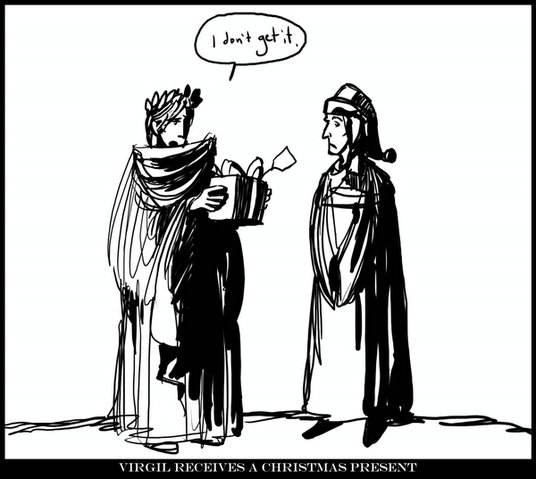 Okay, here's a post appropriate for the holidays-- a Dante comic. It's just dorky enough for my taste. I found it by following a search link (searching blogs for "dante") that led someone to my blog-- the search also listed this post. Many thanks to rubinesque, from whom I snatched this photo-- I only reproduce it (and not only link to it) because I didn't think everyone would follow the link, and they'd miss out on the image. I love that it follows the traditional iconography for Dante and Vergil, too.

Monday, December 19, 2005
'Losers' win...at love!
Who knew my mother could give me such a hot tip? She just informed me that 'Biggest Loser' Matt and runner-up Suzy are now dating. The Biggest Loser was one of the few shows I watched this fall, primarily because of its timeslot before House, the best drama on tv. I guess I should have guessed when Matt let Suzy give him a dramatic haircut towards the end of the season-- only a few episodes before the gang had gone for makeovers at a fancy salon and he'd refused a major cut. Well, best of luck to them both.
Thursday, December 15, 2005
Photo test-- Temple
 So here I am trying out Picasa's blogging feature. This is a photo I took when in Rome in the summer of 2002. It's the temple to the Divine Faustina and Antoninus Pius. Here's a link to an image of the front. I always liked the dramatic look of this shot, it seemed majestic to me.
Tuesday, December 13, 2005
the complexity of Dante's "Vergil"
Here's another quotation that won't make it into the paper, but I wanted to share:
“But Dante’s Vergil, particularly in the Inferno, is far more than a prophetic author and exemplary guide. He is also a tragic figure whose intellectual, emotional and psychological complexity accounts for much of the dramatic energy in Dante’s poem. After all, most of the action of the journey through Hell involves Vergil in some way, usually through his relationship to the pilgrim, himself a creation of the poet. Although Vergil appears most often as a wise guide and a source of knowledge for the pilgrim, there are crucial moments when Dante the poet seems to undermine Vergil’s authority and credibility in order to enrich the aesthetic and moral structure of his poetic universe.”
Guy P. Raffa, “Dante’s Beloved Yet Damned Virgil” in Dante Aligheri, Inferno: The Indiana Critical Edition. ed. and trans., Mark Musa. (Indianapolis , Ind.
“But Dante’s Vergil, particularly in the Inferno, is far more than a prophetic author and exemplary guide. He is also a tragic figure whose intellectual, emotional and psychological complexity accounts for much of the dramatic energy in Dante’s poem. After all, most of the action of the journey through Hell involves Vergil in some way, usually through his relationship to the pilgrim, himself a creation of the poet. Although Vergil appears most often as a wise guide and a source of knowledge for the pilgrim, there are crucial moments when Dante the poet seems to undermine Vergil’s authority and credibility in order to enrich the aesthetic and moral structure of his poetic universe.”
Guy P. Raffa, “Dante’s Beloved Yet Damned Virgil” in Dante Aligheri, Inferno: The Indiana Critical Edition. ed. and trans., Mark Musa. (
Monday, December 12, 2005
Dante, "thinker and poet"
As I work on my Dante & Vergil paper for my Reception course, I find I won't be able to work in this great quotation, so I'm going to share it here. Domenico Comparetti (VMA pg. 199) presents Dante as a poet of the Middle Ages, yet distinguishes what sets him apart from his contemporaries:
"[Dante] has a high opinion of the human intellect, and though he considers its powers as limited, yet he feels a great respect for those of its representatives who were independent of and anterior to the mission of Christ; hence he is not merely acquainted with the ancients through the medium of the schools of grammar, nor does he confine his study of them to what is barely necessary, but he devotes himself directly to them, not as a grammarian or a philologist, still less as a humanist, but as a thinker and a poet."
"[Dante] has a high opinion of the human intellect, and though he considers its powers as limited, yet he feels a great respect for those of its representatives who were independent of and anterior to the mission of Christ; hence he is not merely acquainted with the ancients through the medium of the schools of grammar, nor does he confine his study of them to what is barely necessary, but he devotes himself directly to them, not as a grammarian or a philologist, still less as a humanist, but as a thinker and a poet."
Subscribe to:
Posts (Atom)

